
The Document Web Is Dead
For three decades, the web has operated under a single governing metaphor: the document. Tim Berners-Lee conceived of hypertext as a way to link research papers. Every technology that followed — HTML, CSS, JavaScript, even the modern single-page application — has been an increasingly elaborate way to render, style, and animate what are fundamentally static artifacts.
This model served us well. It democratized publishing, connected billions of people, and created the largest information repository in human history. But it has also calcified into a paradigm that no longer matches our capabilities or our needs.
The web was designed to be read. The next web will be designed to think.
We are witnessing the emergence of a fundamentally different paradigm — one where content is not a fixed artifact but a living, adaptive intelligence. We call this Cognitive Content.
From Retrieval to Reasoning
The first generation of AI integration with web content focused on retrieval. Search engines indexed documents. Chatbots retrieved FAQ answers. Recommendation engines matched users to pre-existing content. In each case, the content itself remained inert — a passive repository waiting to be found.
Retrieval-Augmented Generation (RAG) represented an important step forward, allowing language models to ground their responses in specific document collections. But RAG still treats content as a static knowledge base — a pile of text to be searched and quoted.
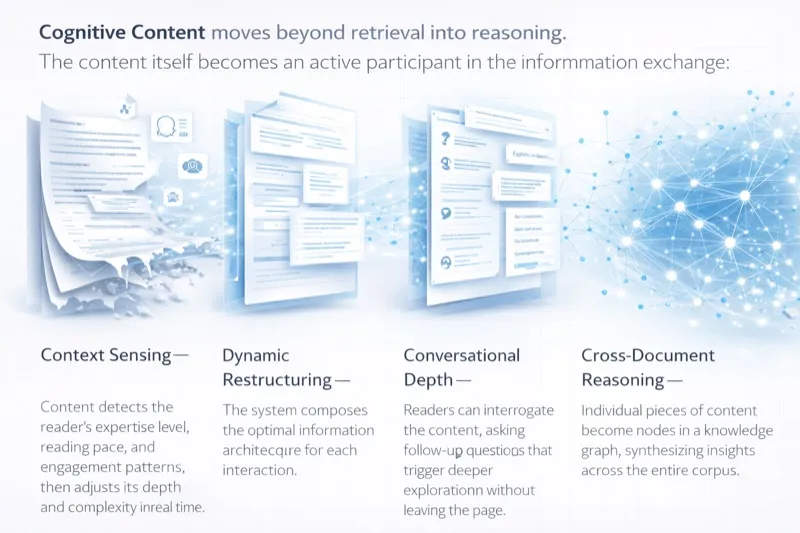
Cognitive Content moves beyond retrieval into reasoning. The content itself becomes an active participant in the information exchange:
- Context Sensing — Content detects the reader's expertise level, reading pace, and engagement patterns, then adjusts its depth and complexity in real time.
- Dynamic Restructuring — Rather than serving a fixed document, the system composes the optimal information architecture for each interaction.
- Conversational Depth — Readers can interrogate the content, asking follow-up questions that trigger deeper exploration without leaving the page.
- Cross-Document Reasoning — Individual pieces of content become nodes in a knowledge graph, synthesizing insights across the entire corpus.
The Architecture of Thinking Content
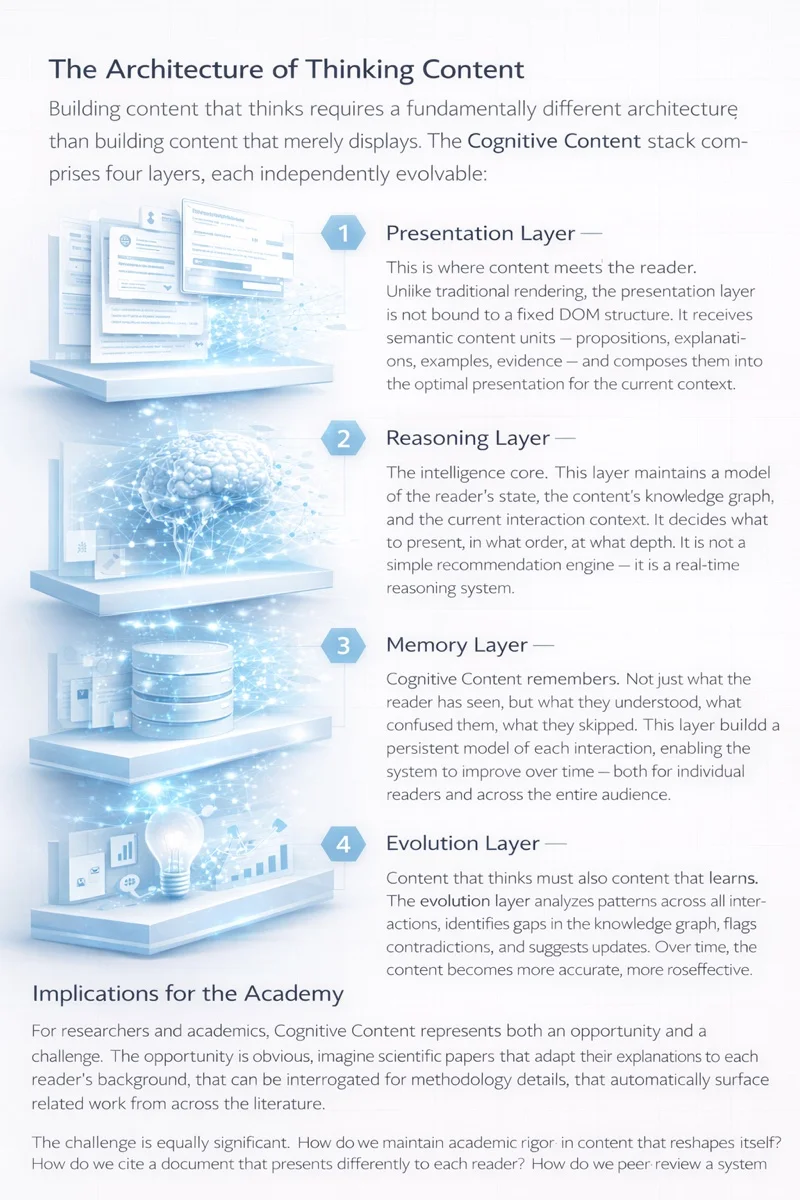
Building content that thinks requires a fundamentally different architecture than building content that merely displays. The Cognitive Content stack comprises four layers, each independently evolvable:
1. The Presentation Layer
This is where content meets the reader. Unlike traditional rendering, the presentation layer is not bound to a fixed DOM structure. It receives semantic content units — propositions, explanations, examples, evidence — and composes them into the optimal presentation for the current context.
2. The Reasoning Layer
The intelligence core. This layer maintains a model of the reader's state, the content's knowledge graph, and the current interaction context. It decides what to present, in what order, at what depth. It is not a simple recommendation engine — it is a real-time reasoning system.
3. The Memory Layer
Cognitive Content remembers. Not just what the reader has seen, but what they understood, what confused them, what they skipped. This layer builds a persistent model of each interaction, enabling the system to improve over time — both for individual readers and across the entire audience.
4. The Evolution Layer
Content that thinks must also content that learns. The evolution layer analyzes patterns across all interactions, identifies gaps in the knowledge graph, flags contradictions, and suggests updates. Over time, the content becomes more accurate, more complete, and more effective.
Implications for the Academy
For researchers and academics, Cognitive Content represents both an opportunity and a challenge. The opportunity is obvious: imagine scientific papers that adapt their explanations to each reader's background, that can be interrogated for methodology details, that automatically surface related work from across the literature.
The challenge is equally significant. How do we maintain academic rigor in content that reshapes itself? How do we cite a document that presents differently to each reader? How do we peer-review a system rather than a static text?
These questions do not have easy answers. But they are the right questions to be asking. The document web gave us unprecedented access to information. The cognitive web will give us unprecedented access to understanding.
What Comes Next
We are at the earliest stage of this revolution. The technologies exist — large language models, knowledge graphs, real-time personalization engines, semantic web standards — but the paradigm has not yet cohered. Most organizations are still bolting AI onto document-era architectures rather than rethinking the architecture itself.
The builders who understand this shift — who can see past the chatbot veneer to the deeper transformation underneath — will define the next era of the web. This publication exists to serve those builders: the researchers, engineers, architects, and technologists who are ready to move from documents to intelligence.
The web is learning to think. The question is whether we will think clearly enough to guide it.

Discussion